
Surgeons are trained to distrust certainty. A colleague who presents a complex revision case and expresses no doubt about the plan invites more scrutiny, not less. Experienced clinicians recognize that confidence and correctness are separate properties, and that the two diverge most often in the cases where the stakes are highest.
Much of clinical AI is built as though the opposite were true. A model reviews an imaging study and returns a recommendation: this approach is better than that one. The output carries no indication of how much the model knows about this particular patient, no account of which anatomy produced the conclusion, and no acknowledgment that a different surgeon weighing different priorities might reasonably choose otherwise.
The problem is not that models produce numbers. Quantitative estimates of outcome are useful, and a carefully constructed number is more honest than a vague impression. The problem is a number presented as a verdict — stripped of the reasoning that produced it and offered in place of clinical judgment rather than in support of it.
Overconfidence Is the Default Behavior
Modern neural networks tend toward overconfidence. Left untreated, they produce probabilities clustered near zero and one regardless of how much evidence supports them. Guo and colleagues documented this systematically, showing that the accuracy improvements of the past decade arrived alongside a measurable deterioration in calibration [1]. Newer models are better at being right and worse at knowing when they are.
The consumer parallel is familiar. A language model that fabricates a citation does so in the same assured tone it uses for correct answers, and the fluency is what makes the error dangerous. Surgical prediction models fail differently but with the same underlying character. They do not invent findings. They assert a preference between operations with a confidence the underlying evidence does not support — and they do it silently, in the same interface, with the same visual weight as a well-founded result.
For a surgeon this is the worst available failure mode, because it removes the very signal that would otherwise prompt appropriate skepticism.
Calibration: Does Seventy Percent Mean Seventy Percent?
There is a simple way to test whether a model’s numbers mean anything. Gather every patient the model gave a seventy percent chance of a good outcome. Follow them. Count how many did well. If roughly seventy of every hundred did, the number meant what it said. If only fifty-six did, the model produced a figure with no fixed relationship to reality.
That property is called calibration: a model is calibrated when its stated probabilities match observed frequencies. Unlike most claims made about clinical software, it can be checked against outcomes — and the gap between stated and observed rates is itself a measurable quantity, not a matter of opinion.
Calibration is not the same as accuracy, and the two are easy to conflate. Accuracy asks whether the model put the right patients in the right order. Calibration asks whether the labels attached to that order are true. A model can do the first perfectly and fail the second completely, ranking every patient correctly while overstating its confidence in all of them. Area under the curve, the statistic the surgical literature reports most often, measures only the ordering. It is silent on whether a seventy means seventy.
The consequence reaches the consent conversation. A surgeon who quotes an uncalibrated probability is citing a figure that corresponds to no observed rate of anything, to a patient who reasonably assumes it does.
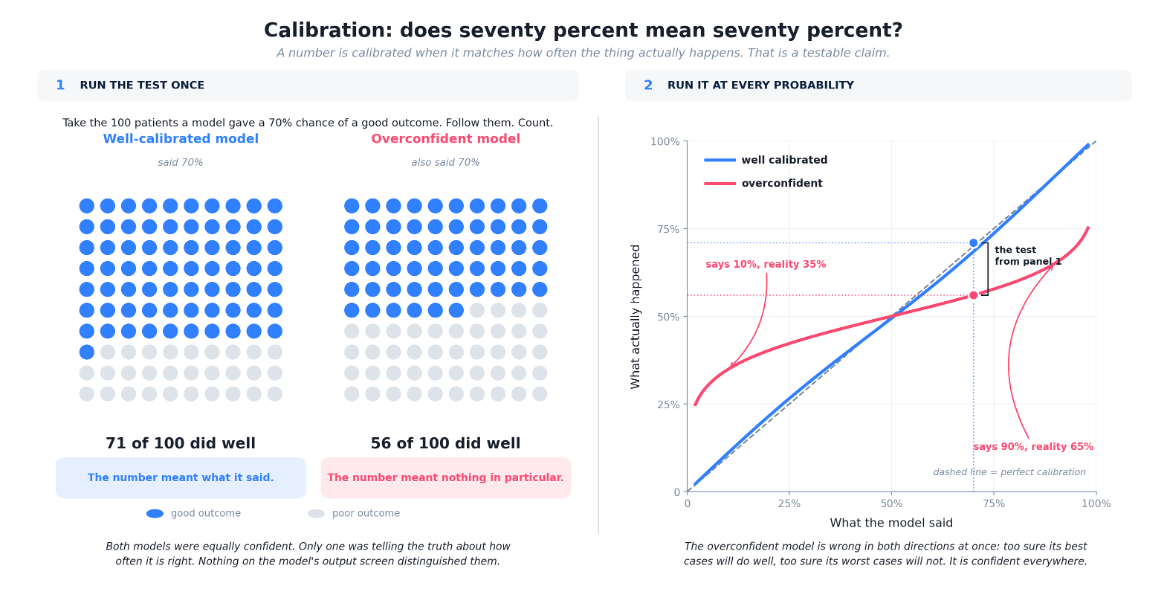
Repeat that count across the full range and the pattern becomes visible. An overconfident model errs in both directions at once, treating its best cases as safer than they are and its worst cases as worse. It is confident everywhere and correct at neither end.
Methods for correcting this are well established. Ensembles train multiple models and treat their disagreement as a measure of confidence [2]. Conformal prediction supplies formal coverage guarantees that hold without assumptions about the shape of the data or the correctness of the model [3]. The statistical techniques are not the obstacle. The obstacle is a product decision to present output as an answer rather than as evidence.
What the Model Knows and What It Does Not
Uncertainty in a surgical prediction has two distinct sources, and they carry different clinical implications.
The first is irreducible variation — what the literature calls aleatoric uncertainty. Among patients who resemble one another in every measured respect, some recover well and some do not. The model has seen many such patients, and the spread it reports reflects real biology rather than a deficiency in the model. Collecting more data would not narrow it.
The second is the model’s own ignorance — epistemic uncertainty. This patient sits at the edge of what the model has encountered. The combination of vertebral bone quality, paraspinal muscle profile, and vascular findings is uncommon in the training population, and the model is extrapolating rather than recalling.
A surgeon should act differently in each case. Variation grounded in biology supports a shared decision-making conversation. Uncertainty grounded in an unfamiliar patient is a signal to weight the model lightly. A system that reports only its preferred operation collapses both into an output that looks identical.
How SDI Reports This
Surgeon Decision Intelligence (SDI) does not issue a recommendation. The platform reports three things, and the surgeon assembles them.
The first is an attention heatmap over the imaging study, showing which anatomy the durability model actually weighted. Facet joints, the disc and endplate interface, the pedicle corridor, adjacent level anatomy, and paraspinal soft tissue each appear or do not. A surgeon can confirm that the model is reasoning about anatomy that matters for this patient — or see that it is not.
The second is the failure mode implied by how those regions relate to one another. Attention concentrated in the disc and endplate at a single level implies a different mechanism than attention distributed across facets at two levels. The co-activation of regions carries information that no region carries alone, and the platform names the resulting mechanism: cage subsidence, adjacent segment degeneration, proximal junctional failure. Naming the mechanism separates factors that a change in the construct can address from factors that belong in a counseling conversation instead.
The third is the same analysis run across every operation under consideration. A durability estimate for one plan is difficult to interpret in isolation. The same estimate placed beside the alternatives for that patient, each with its own leading failure mode, is a decision aid.
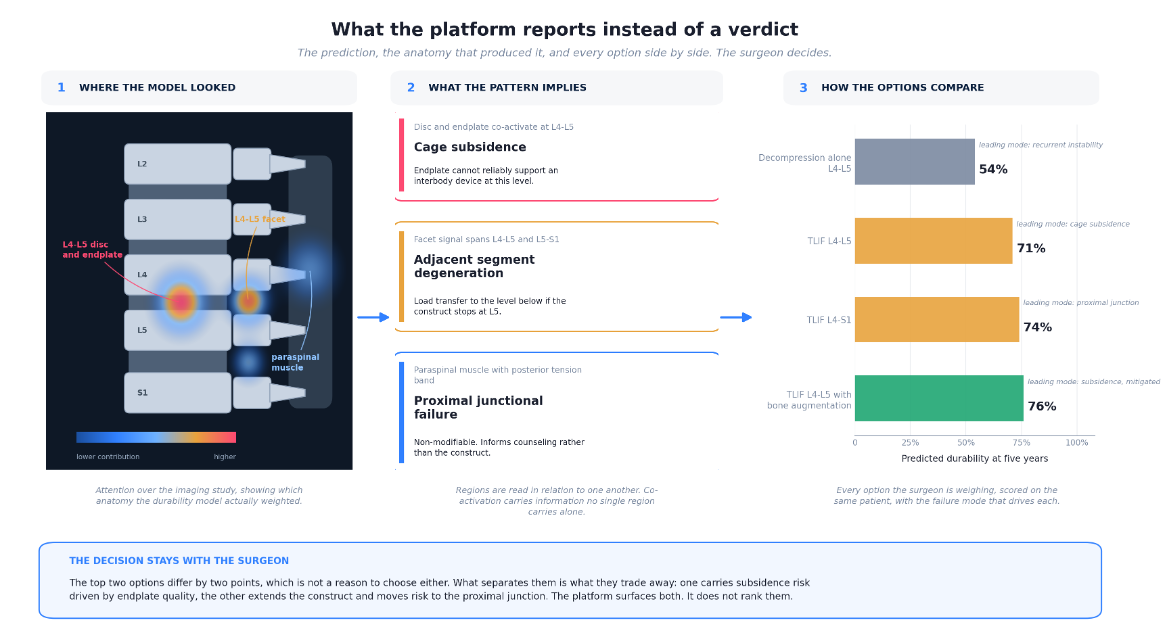
Options frequently land within a few points of one another. That is the ordinary case rather than the exception, and it is precisely where a system that names a winner does the most damage. Two constructs separated by two percentage points are not meaningfully distinguishable on the number. They are distinguishable on what each one trades away, and that judgment depends on the patient’s goals, the surgeon’s experience with each approach, and considerations never present in the imaging.
Conclusion
Surgeons do not want a machine that is certain. They want output that is calibrated, that shows its anatomic reasoning, that distinguishes a hard case from an unfamiliar one, and that presents the alternatives rather than selecting among them. Those are the properties that make a senior colleague worth consulting, and there is no reason to hold software to a different standard.
References
[1] Guo C, Pleiss G, Sun Y, Weinberger KQ. On Calibration of Modern Neural Networks. In: Proceedings of the 34th International Conference on Machine Learning (ICML). 2017;70:1321-1330.
[2] Lakshminarayanan B, Pritzel A, Blundell C. Simple and Scalable Predictive Uncertainty Estimation using Deep Ensembles. In: Advances in Neural Information Processing Systems (NeurIPS). 2017;30.
[3] Angelopoulos AN, Bates S. A Gentle Introduction to Conformal Prediction and Distribution-Free Uncertainty Quantification. arXiv:2107.07511. 2021. See also Vovk V, Gammerman A, Shafer G. Algorithmic Learning in a Random World. Springer; 2005.