
The Science Behind SDI
Every biomarker in the SDI Platform is backed by peer-reviewed research. Led by our founding team at Hospital for Special Surgery, our work has produced 236+ publications demonstrating that soft tissue health predicts surgical outcomes.

Investigating the intelligence surgeons need before they enter the operating room
Our research asked a different question
Can we extract quantitative biological information from standard imaging?
Can we measure tissue quality, not just anatomy?
The answer is yes.
And that discovery forms the foundation of Surgeon Decision Intelligence.

Our Discovery Journey
Spine-Specific Sarcopenia
Finding
Preoperative atrophy of the posterior paraspinal muscle is associated with a future adjacent segment disease (ASD) revision surgery, with fatty infiltration of the multifidus being the key imaging predictor.
Clinical Impact
Assessment of not only bone, disc, and neural structures, but also of the surrounding muscular envelope on MRI, may be key for improved patient counseling and surgical decision-making.
Abdominal Aortic Calcification (AAC)
Finding
AAC is independently associated with posterolateral fusion impairment following spinal fusion surgery.
Clinical Impact
Routine preoperative assessment of AAC on lateral spine radiographs may help identify patients at higher risk for impaired fusion and guide surgical decision-making.
MRI-derived vertebral bone quality (VBQ) score
Finding
Higher MRI-derived VBQ score (indicative for lower bone quality) is an independent risk factor for pedicle screw loosening following instrumented transforaminal lumbar interbody fusion (TLIF).
Clinical Impact
MRI-based VBQ score shows good predictive ability for screw loosening and may be an alternative for preoperative bone quality evaluation.
Modic Changes (MC)
Finding
Vertebral endplate bone marrow lesions (Modic changes), particularly Modic type 2 changes (MC2), are associated with inferior long-term clinical outcomes after decompression surgery for lumbar spinal stenosis.
Clinical Impact
MC2 may serve as a prognostic marker of advanced degeneration and may be associated with reduced recovery following decompression surgery.
Disc signal intensity index (DSI2)
Finding
Average DSI2 is an independent risk factor for EuroQol Group 5 Dimension 5-Level Quality of Life (EQ-5D-5L) scores and corresponds to degree of disc degeneration severity.
Clinical Impact
The DSI2 method is a promising alternative for disc research that detects subtle progression of disc degeneration and associates with patient-reported outcomes.
Intervertebral Vacuum Phenomenon
Finding
The presence of IVP in degenerative disc disease is a sign of segmental instability.
Clinical Impact
This is important for planning spinal fusion surgery.
Facet Effusion
Finding
In degenerative spondylolisthesis, facet joint fluid on MRI is linked to dynamic instability.
Clinical Impact
The presence of facet fluid and dynamic instability may predict increased likelihood of achieving MCID for improvement in back pain following posterior lumbar fusion.
AI-powered research, guided through every step
Research Connect turns clinical questions into publication-ready answers — no statistician, no code, no waiting. Surgeons and researchers ask in plain language and get back rigorous, validated analyses they can defend.
Built on a multi-step pipeline engineered for medical data, where the right test is selected, the cohort is filtered, and every step is reviewable before the next begins.
Ask
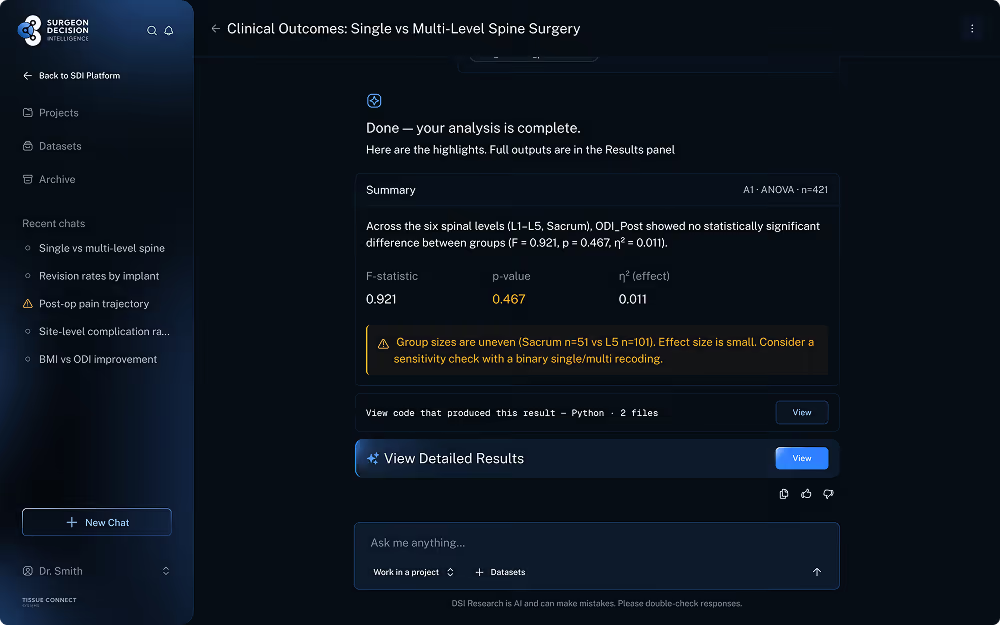
Type your question in plain English — no SQL, no R, no statistical notation required. Whether it's revision rates by implant or post-op pain trajectories, Research Connect understands what you're actually asking.

Analyze
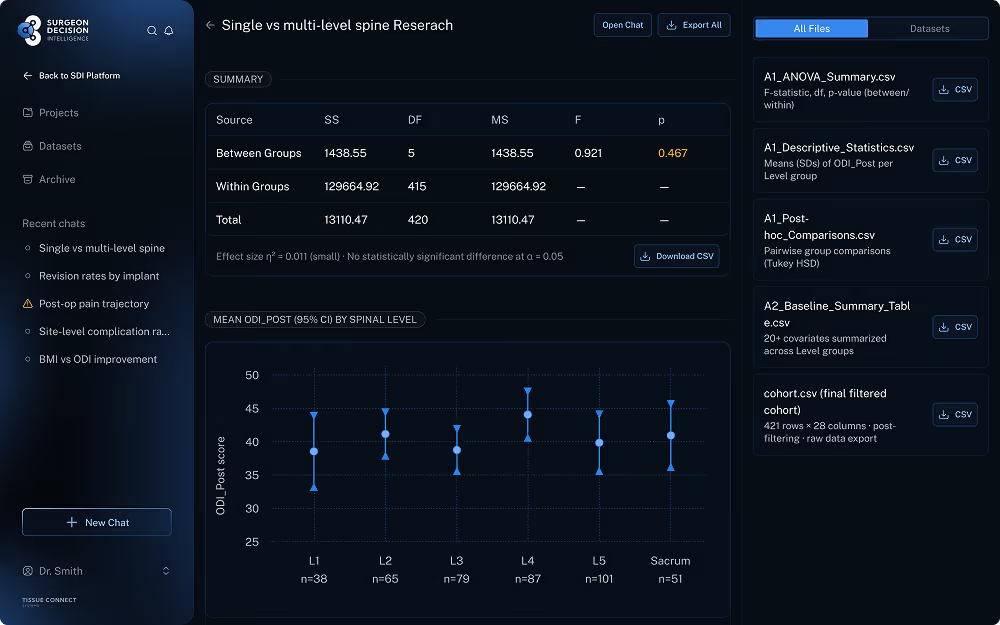
A multi-step, schema-validated pipeline selects the methodologically correct test based on variable type, distribution, and study design. Every intermediate output is reviewable — eliminating the most common source of error in clinical research
Publish
Generate publication-ready summaries, tables, and figures from a single conversation. Outputs are organized into Projects for longitudinal study management and full analytic traceability.

let us show your how we can support your research
The SDI Platform makes it possible to capture quantitative soft tissue biomarkers quickly, consistently, and at scale from standard clinical imaging. What once required time-intensive manual review can now be measured across large datasets, opening the door to broader and more efficient research