
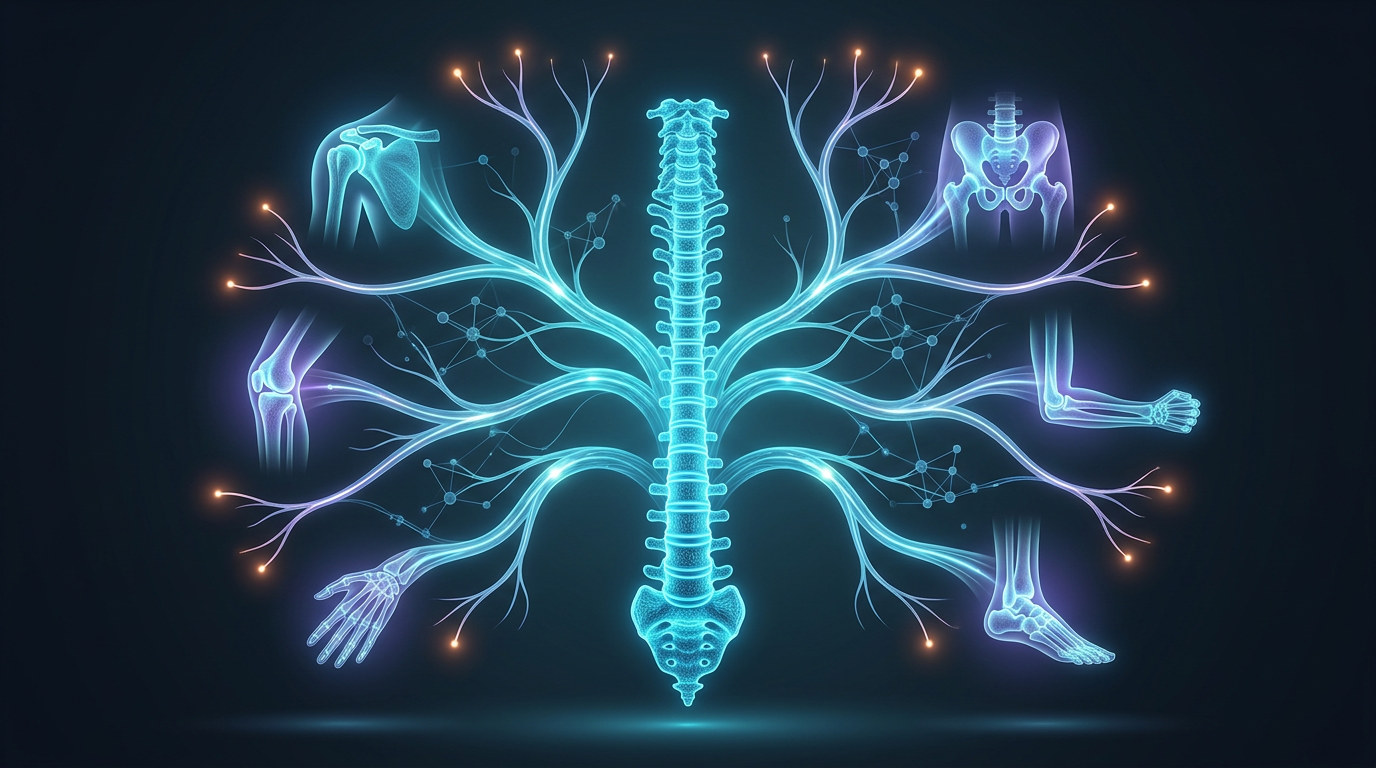
Medical imaging is midway through a transition that natural language processing finished several years ago. The old approach built a separate model for every task, each trained from scratch on its own hand-labelled dataset. The new approach trains one large model on an enormous quantity of unlabeled data, then adapts that single model to many tasks with comparatively little labelled data for each.
For surgery this matters more than it does for most fields, because the binding constraint in surgical AI has never been ideas or computing power. It is labelled data. Every label requires a trained clinician to review a study and record what it shows, and that time is the scarcest resource in the pipeline.
Why the Task-Specific Approach Runs Out of Room
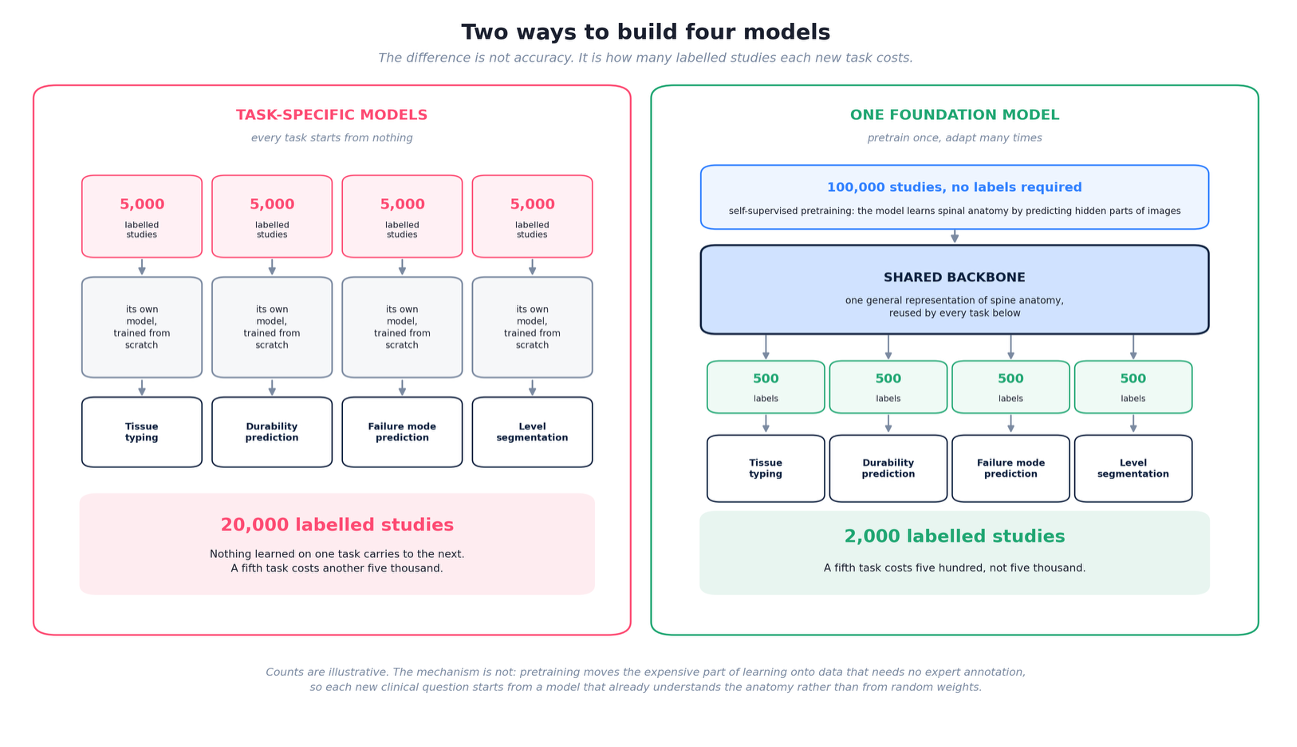
Consider four questions a surgical imaging platform might be asked to answer: what tissue is present at this level, how durable is a proposed construct, which failure mode is most likely, and where does one vertebral level end and the next begin.
Under the task-specific approach each question gets its own model, and each model starts from random weights that know nothing about spinal anatomy. Every one of them has to learn, independently and from labelled examples, that vertebral bodies are stacked, that discs sit between them, and that a facet joint looks different from a pedicle. Four models means learning the same anatomy four times and paying for the labels four times.
Cost scales linearly with the number of questions asked. A fifth question costs as much as the first, and nothing accumulates across them.
Pretraining and Fine-Tuning
The foundation model approach splits learning into two stages that have very different costs.
The first stage is pretraining, and it uses no labels at all. The model is shown a large collection of imaging studies with portions hidden, and is asked to reconstruct what was concealed. Predicting a masked region of a spine MRI is only possible if the model has learned what spinal anatomy normally looks like, so the exercise forces it to build an internal representation of structure, texture, and the relationships among adjacent tissues. No clinician annotates anything. The supervision comes from the images themselves.
The second stage is fine-tuning. The pretrained model, now holding a general representation of the anatomy, receives a small labelled dataset for a specific clinical question and learns to map what it already understands onto that question. Because it is no longer learning anatomy from nothing, it needs far fewer examples.
The published evidence for this is now reasonably strong. Zhou and colleagues pretrained a vision transformer on 1.6 million unlabelled retinal images, then adapted it to a range of diagnostic and prognostic tasks. The adapted model outperformed comparison models trained conventionally, and it did so with less labelled data [1]. Moor and colleagues describe the general pattern as the direction medical AI is heading, toward models built by self-supervision on large diverse datasets and then applied flexibly across tasks [2].
What This Changes for a Specialty Short on Labels
Surgical outcome labels are unusually expensive. A radiology label can often be assigned by reading the study. A surgical durability label cannot, because it requires knowing what happened to the patient over the following years. The label does not exist until someone follows the patient and records the result.
This is why the foundation model approach fits surgery so well. Imaging accumulates continuously and requires no annotation to be useful for pretraining. Outcome data accumulates slowly and expensively. Separating the two stages means the abundant resource carries most of the learning, and the scarce resource is spent only where it cannot be substituted.
What SDI Pretrained On
Surgeon Decision Intelligence has trained its foundation model on a corpus of roughly 100,000 spine MRIs, linked to 41,000 operative reports and supported by X-ray and CT alongside the MRI. Two-year follow-up across the full cohort is approximately 90 percent.
The follow-up figure constrains what the data can support more than the others do. Loss to follow-up is not random. Mannion and colleagues, examining a registry of more than 15,000 spine patients, found that patients who do not return differ systematically from those who do, and that failing to account for them causes treatment success to be overestimated [3]. A cohort with substantial attrition does not simply contain less information. It contains information biased toward good outcomes, and a model trained on it will inherit that optimism. Retention near 90 percent is the difference between a dataset that describes what happens to patients and one that describes what happens to the patients who came back.
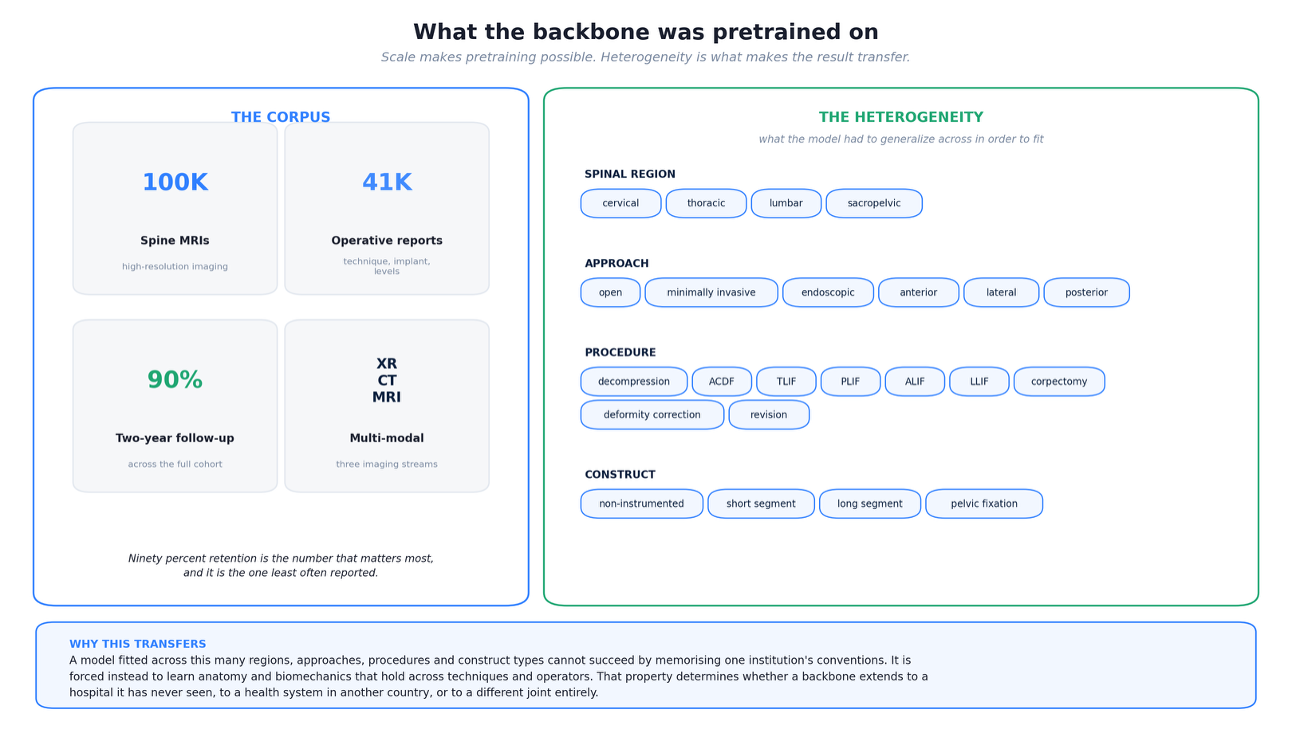
Scale determines whether pretraining is feasible. Breadth determines whether the result generalizes. A model pretrained on 100,000 studies drawn from a narrow slice of practice would learn that slice thoroughly and transfer poorly. This corpus spans cervical through sacropelvic, open and minimally invasive and endoscopic, anterior and lateral and posterior, decompressions through deformity corrections and revisions, non-instrumented constructs through pelvic fixation.
A model asked to fit all of that cannot succeed by memorizing one institution's habits, because the corpus does not contain one institution's habits. It has to find the anatomy and biomechanics that hold across techniques, which is precisely the kind of representation that survives contact with a hospital it has never seen.
Why the Backbone Extends Beyond the Spine
What pretraining produces is not a spine model. It is a representation of musculoskeletal structure: cortical and trabecular bone, cartilage, disc and ligament, tendon and muscle, degenerative change, and the appearance of implanted hardware against all of it. Those tissues are the same tissues in a knee, a hip, or a shoulder, and they behave under load according to the same mechanics.
This makes the backbone a starting point for questions well outside the spine. Arthroplasty poses a structurally identical problem: preoperative imaging, a choice among procedures and implants, and a durability question answered years later by revision, loosening, periprosthetic fracture, or wear. A model that has learned to read bone quality, joint surface integrity, and soft tissue envelope from a spine corpus already holds much of what a knee or hip durability model needs. It requires a fine-tuning dataset for the new joint rather than a new backbone, and a new anatomical region becomes a labelling project rather than a research program.
Multi-modal pretraining is what makes this credible rather than speculative. Spine work is MRI-heavy while arthroplasty is driven substantially by plain radiography and CT. A backbone pretrained on only one modality would transfer poorly across that boundary. One exposed to X-ray, CT, and MRI during pretraining has learned to recognize the same anatomy through different physics, which is the specific capability cross-joint transfer requires.
The strategic implication follows from the economics described earlier. The cost of a foundation model is concentrated in pretraining, and pretraining is amortized across everything built on top of it. A backbone built for spine and validated there is also the substrate for the rest of musculoskeletal surgery, which is the argument Moor and colleagues make for generalist medical models in the broader clinical setting [2].
Conclusion
The shift from many narrow models to one adaptable model is not primarily a story about accuracy. It is a story about what becomes affordable. When each new clinical question costs five hundred labelled studies instead of five thousand, questions that were never worth pursuing become tractable, and a platform can answer the question a surgeon actually asked rather than the one it happened to be built for. For a specialty where the labels are counted in years of patient follow-up, that difference is substantial.
References
[1] Zhou Y, Chia MA, Wagner SK, et al. A foundation model for generalizable disease detection from retinal images. Nature. 2023;622(7981):156-163.
[2] Moor M, Banerjee O, Abad ZFH, et al. Foundation models for generalist medical artificial intelligence. Nature. 2023;616(7956):259-265.
[3] Mannion AF, Fekete TF, O'Riordan D, et al. Does loss to follow-up lead to an overestimation of treatment success? Findings from a spine surgery registry of over 15,000 patients. Eur Spine J. 2023;32(3):813-823.