
Research Connect: Turning Clinical Questions Into Publication-Ready Analyses With a Surgeon in the Loop
Clinical research in spine and orthopedic surgery has a persistent bottleneck. Surgeons generate questions faster than research teams can answer them, and most of those questions never move past the hallway conversation. Data lives across imaging archives, registries, spreadsheets, and institutional silos. Statistical analysis often requires a dedicated biostatistician, a research coordinator, and weeks of back and forth. The result is that important clinical questions go unanswered, and the questions that do get answered often reflect what was easy to analyze rather than what was most clinically meaningful.
Research Connect is designed to change that pattern. It is the research layer of the SDI platform, built to support surgeons who want to interrogate their own outcomes, compare their patients against national and international cohorts, and produce rigorous analyses without leaving the clinical workflow. The platform combines automated quantitative imaging biomarker extraction with a surgeon directed conversational interface and a structured statistical pipeline. Each of these components addresses a distinct barrier to clinical research, and together they allow surgeons to move from clinical question to publication ready output in a single session.
This article outlines the three core capabilities of Research Connect and explains how they reinforce one another. The emphasis throughout is on the surgeon in the loop model, which is what makes the platform methodologically defensible and clinically useful.
Automated Quantitative Imaging Biomarker Extraction at Scale
The foundation of any surgical research effort is the data itself. Traditional imaging studies contain a large amount of biological information that is rarely used in outcomes research because extracting it manually is prohibitively slow. A single MRI can yield dozens of measurable tissue level signals, but converting those signals into structured data across thousands of studies has historically required a dedicated imaging research team.
The SDI platform automates that process. It extracts more than twenty Quantitative Imaging Biomarkers from routine MRI studies, including muscle quality, disc signal, endplate changes, vertebral bone quality, vascular calcification, and neurological compression metrics. A full description of the biomarker library is available on the SDI platform page. For research purposes, the practical implication is significant. A surgeon can build a cohort of several thousand patients and have every one of those patients characterized across twenty or more objective imaging derived variables before any analysis begins.
This capability transforms the kinds of questions that can be asked. Instead of studying revision risk based on age and BMI alone, a surgeon can study revision risk in the context of paraspinal muscle quality, aortic calcification burden, and disc signal intensity. Instead of asking whether outcomes differ between two implant types, a surgeon can ask whether outcomes differ between two implant types after controlling for measurable tissue biology. The research becomes richer because the underlying data is richer, and the underlying data is available because the extraction is automated.
Surgeon Directed Conversational Analysis With Validated Statistics
The second and most differentiating capability of Research Connect is the conversational analysis layer. Surgeons ask questions in plain language and receive validated statistical output. The key word is validated. Research Connect is not a general purpose chatbot generating code and hoping the output is correct. It is a structured pipeline that treats each surgeon question as a formal analytic request and moves it through a series of methodologically defensible steps.
The workflow begins in the query interface, where the surgeon enters a clinical question and selects the relevant datasets.
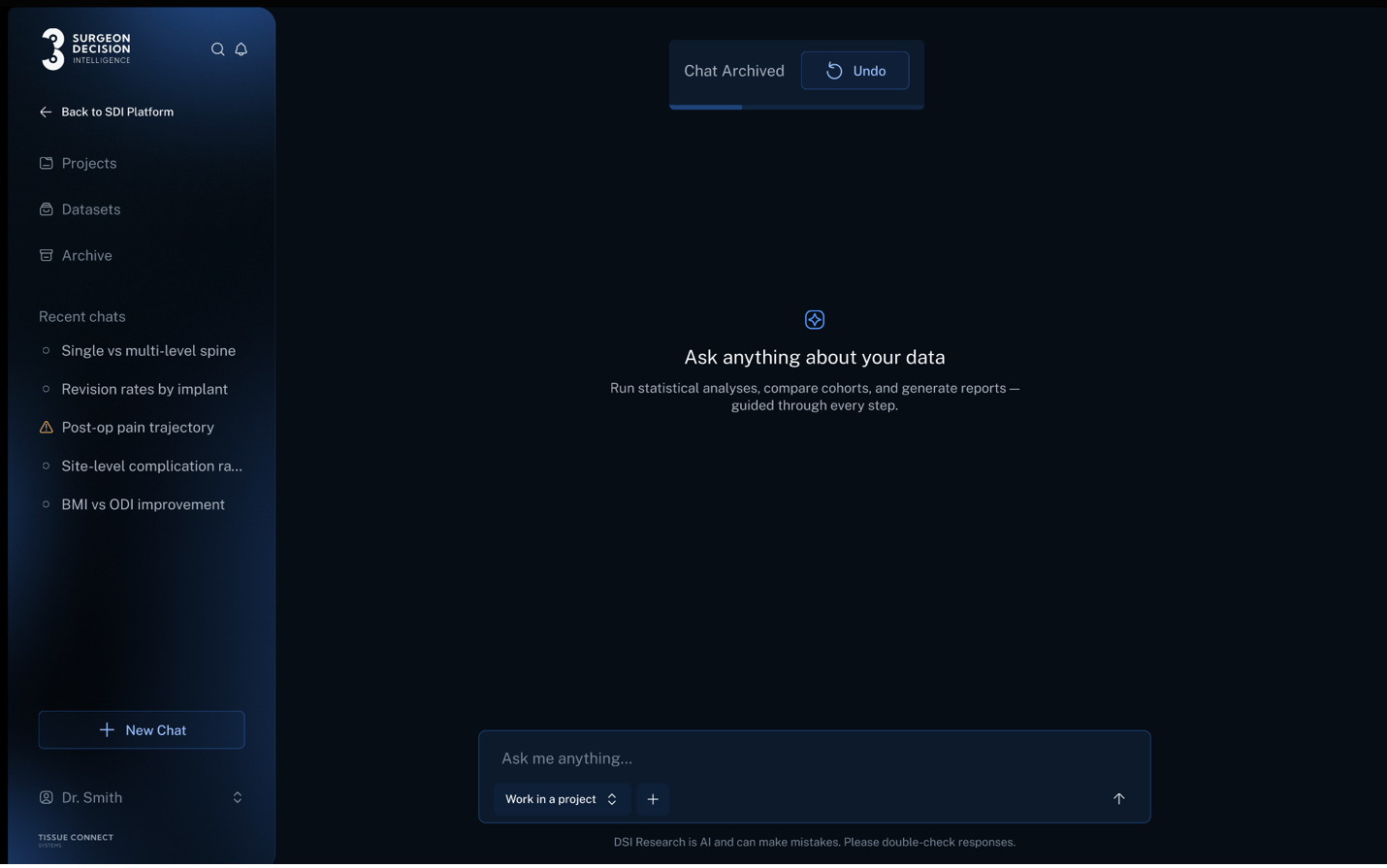
Once a question is submitted, the system translates it into a structured analytic plan. It identifies the cohort, selects the appropriate statistical test based on variable type, distribution, and study design, and runs the analysis. Critically, every intermediate step is reviewable. The surgeon can see how the cohort was defined, which variables were included, which test was chosen, and why. If the system detects a potential methodological concern, such as uneven group sizes or a small effect size, it surfaces that concern directly in the output rather than burying it in a footnote.

This is the surgeon in the loop model in practice. The surgeon controls the question, reviews the analytic plan, and interprets the results in clinical context. The platform enforces statistical rigor and prevents the most common sources of error, including inappropriate test selection, unaccounted for distributional assumptions, and unrecognized cohort imbalances. Neither component operates alone. The surgeon provides clinical judgment and the platform provides methodological discipline.
Research Connect also supports cross institutional comparison. A surgeon can compare local outcomes against aggregated data from other participating institutions, which is particularly valuable for benchmarking, identifying practice variation, and generating hypotheses about site level differences in technique or patient selection.
Publication Ready Tables, Figures, and Traceability
Analysis is only useful if it can be communicated. The final component of Research Connect generates the outputs that surgical research actually requires, including summary tables, descriptive statistics, post hoc comparisons, effect size estimates, and figures suitable for manuscript submission.
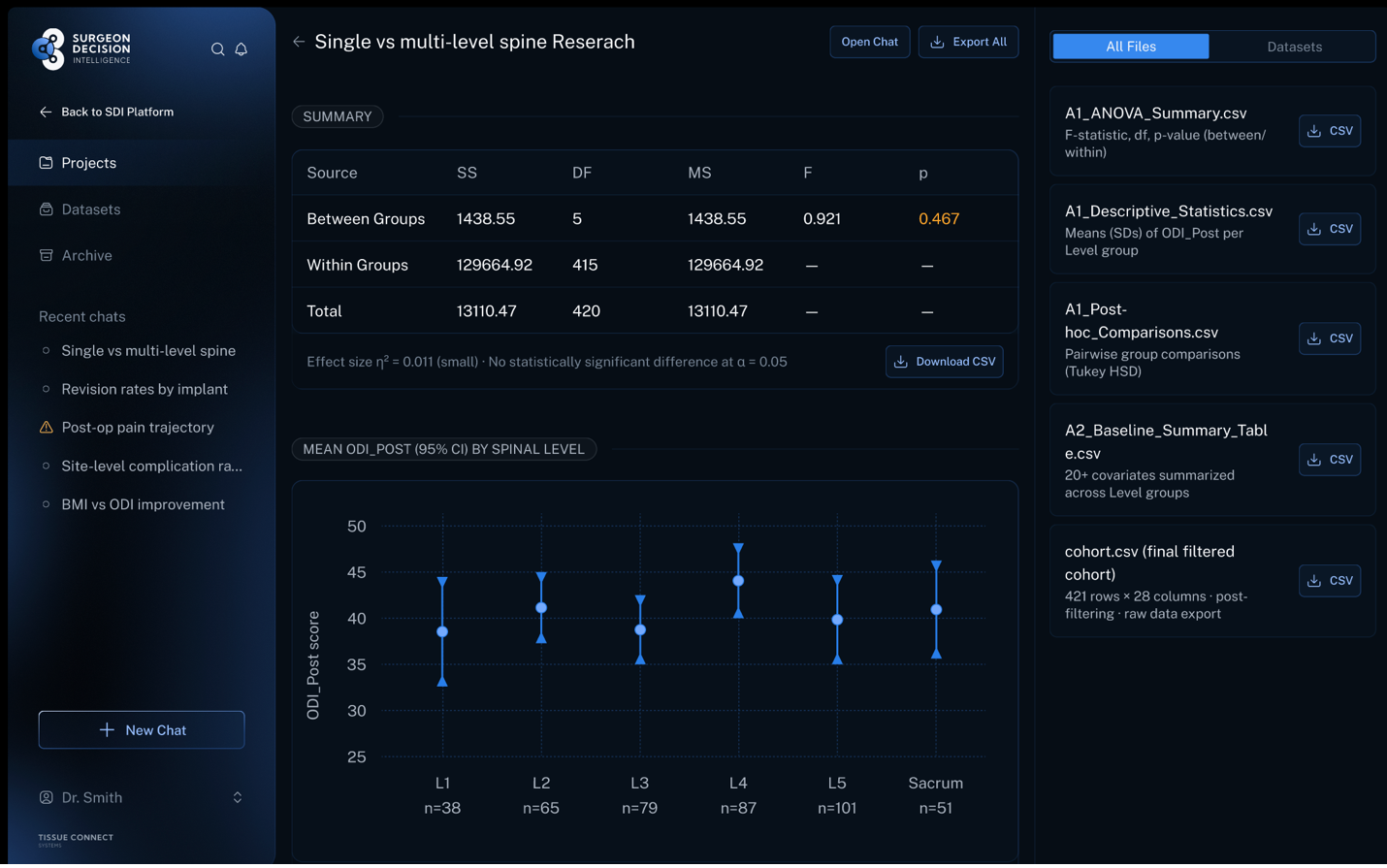
Every output is exportable, and every analysis is traceable. The platform preserves the full analytic record, including the original question, the cohort definition, the statistical test, the parameters, and the final results. This traceability matters for two reasons. First, it supports reproducibility, which is increasingly expected by journals and regulatory bodies. Second, it allows the surgeon to defend the analysis in peer review, in departmental research meetings, or in front of any reviewer who asks how a specific number was generated.
Analyses are organized into Projects, which allow longitudinal management of a research program rather than one off queries. A surgeon studying revision risk across implant types can maintain that project over months, adding new patients as they accumulate and rerunning analyses as the cohort grows.
Why the Surgeon in the Loop Model Matters
The three benefits described above are not independent. They work because they are integrated under a single principle. The surgeon defines what matters clinically. The platform ensures the analysis is methodologically sound.
This model is important because it addresses the two failure modes that have historically limited AI in clinical research. Fully autonomous analytic systems produce output that surgeons cannot verify and reviewers will not trust. Fully manual research pipelines produce output slowly and at limited scale. Research Connect occupies the space between these extremes. It gives surgeons the speed and scale of an automated system while preserving the clinical judgment and methodological transparency that rigorous research requires.
Research Partnership
Research Connect is available to institutions and investigators interested in surgical outcomes research, imaging biomarker studies, and multi center comparative analyses. If your group is interested in exploring a research partnership with SDI, please contact us to discuss collaboration opportunities, data access, and integration with your institutional research program.